
One of America’s most famous food stories begins with 260 tons of unsold Thanksgiving turkey. According to the tale, C. A. Swanson & Sons packed the birds into refrigerated railroad cars, kept the trains moving so the refrigeration would work, and asked employees in Omaha, Nebraska, to find a way to sell the enormous surplus.
The solution, the story continues, was the TV dinner: turkey and gravy, cornbread dressing, peas, and sweet potatoes arranged in a divided aluminum tray and sold in a box that looked like a television set.
It is a perfect Thanksgiving origin story. It is also far less certain than it is usually presented.

Frozen dinners came before the “TV Dinner”
Swanson did not invent the idea of freezing a complete meal in separate compartments. The Library of Congress traces the concept at least to Maxson Food Systems, which made “Strato-Plates” for military and civilian airline passengers in 1945. Each plate held meat, a vegetable, and a potato. They were reheated for travelers rather than sold in grocery stores, but the basic arrangement was already there.
Other companies moved the idea closer to the home freezer. Jack Fisher’s FridgiDinners were sold to bars and taverns in the late 1940s. In 1949, brothers Albert and Meyer Bernstein formed Frozen Dinners, Inc., and sold complete frozen meals in three-compartment aluminum trays under the One-Eyed Eskimo label. Their Pittsburgh-area business grew into Quaker State Food Corporation, which had sold more than 2.5 million frozen dinners by 1954.
What Swanson did was turn an existing idea into a national phenomenon.
A meal packaged for the television age
Swanson introduced its frozen TV Dinner in the early 1950s and put the product into widespread distribution in 1954. The name was the real breakthrough. Instead of selling the meal only as a labor-saving food, the company connected it to the appliance that was changing American living rooms.
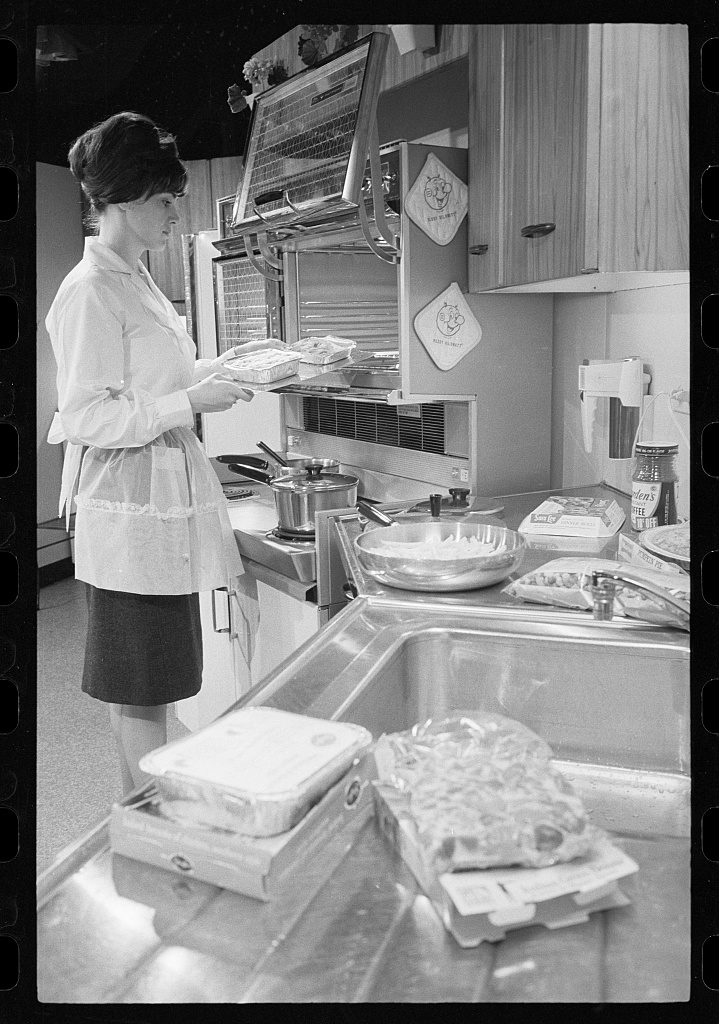
The package resembled a television set. The divided aluminum tray could go directly from freezer to oven, then serve as the plate. The compartments kept the foods separate, and there were no dishes to wash. At 98 cents, it offered a complete turkey dinner that could be ready in about 25 minutes.
The timing could hardly have been better. Television ownership was rising rapidly, and eating in front of the set was becoming a recognizable part of American life. The National Museum of American History notes that by 1960 nearly 90 percent of American homes had a television. Folding TV trays soon offered an alternative to the dining table.
The product also reflected changing expectations inside the home. More women were working outside the home, yet they were still generally expected to prepare family meals. Swanson’s advertising presented the frozen dinner as a modern answer: little preparation, little cleanup, and a meal that still looked complete.
It worked. Swanson sold about 10 million dinners in 1954, its first full year of production. Competitors followed, and the term “TV dinner” became so familiar that people used it for an entire category of frozen meals.
Who deserves the credit?
That depends on whom you ask.
For years, Swanson salesman Gerry Thomas was widely described as the inventor. Thomas said he saw aluminum trays used for airline meals and proposed a three-compartment version for Swanson. He also took credit for the television-style package and the name.
But other Swanson employees offered a different account. Betty Cronin, a bacteriologist who worked on the product, said brothers Gilbert and Clarke Swanson developed the concept while the company’s marketing and advertising teams shaped the name and packaging. Cronin helped solve one of the meal’s most important technical problems: making foods with different cooking requirements finish at the same time.
The Library of Congress therefore avoids naming a single inventor. Maxson, Fisher, the Bernstein brothers, Thomas, Cronin, the Swanson brothers, and numerous unnamed food scientists, factory workers, marketers, and package designers all contributed pieces of the idea.
What about the trainload of turkey?
The turkey-surplus story remains the most memorable part of the legend, but it should not be repeated as unquestioned fact.
In a 2005 examination of Thomas’s account, the Los Angeles Times reported that former Swanson employees disputed both the scale of the surplus and the claim that refrigerated railcars had to travel back and forth across the country to keep the meat frozen. Thomas later described the railcar episode as a metaphor.
That does not mean there was no extra turkey, or that Thanksgiving had nothing to do with the first Swanson meal. It means the neat story of one salesman rescuing 260 tons of leftovers has grown larger and simpler through repetition.
The more accurate version is also more interesting: Swanson recognized a changing market, borrowed from earlier frozen-meal systems, solved difficult production problems, and wrapped the result in the language of the television age.
From aluminum trays to microwave meals
The earliest Swanson trays had three compartments. Dessert was added as a fourth component around 1960. By the 1980s, as microwave ovens became common, Swanson moved from aluminum to microwave-safe plastic trays.
The words “TV dinner” eventually disappeared from Swanson packaging, but the idea survived. Frozen entrées, microwave meals, meal kits, and other heat-and-eat foods still follow the same promise: a complete meal, divided into familiar parts, requiring as little time and cleanup as possible.
So did Thanksgiving leftovers invent the TV dinner? Not exactly. They may have helped shape Swanson’s first nationally famous version, but frozen complete meals already existed. Swanson’s true achievement was taking the divided frozen dinner out of airplanes, taverns, and regional markets—and placing it in millions of American living rooms.
Sources
- Library of Congress: “Who invented the TV dinner?”
- National Museum of American History: “No Work, No Dishes”
- Smithsonian Institution: Swanson TV Dinner Tray, catalog no. 1987.0265.01
- History Nebraska: “How a Nebraska company changed Americans’ eating habits”
- Los Angeles Times: “False tales of turkey on a tray”
- Library of Congress photograph record: “Convenience foods”
If you enjoy the unexpected history behind everyday things, you can help me keep researching and sharing these stories at Buy Me a Coffee.


Leave a Reply